


The dream of Africa—vast horizons stretching endlessly, wildlife moving in numbers that defy modern experience, landscapes untouched by time—finds its truest expression in Tanzania. For those seeking safaris in Tanzania, the promise extends beyond simple wildlife viewing to encompass complete immersion in functioning ecosystems where nature’s ancient rhythms continue uninterrupted. Here, in this East African nation blessed with extraordinary geographic diversity and unwavering conservation commitment, the safari experience reaches its zenith through encounters that awaken primal connections to wilderness most modern humans have long forgotten.
Safaris in Tanzania stand apart from ordinary wildlife tours through their authenticity and scale. This isn’t viewing animals in enclosures or watching habituated wildlife fed by rangers—this is entering genuine wilderness where predators hunt according to their own schedules, prey animals employ survival strategies refined over millennia, and humans occupy the role of privileged observers rather than managers. The landscapes themselves inspire awe: the Serengeti’s golden plains extending to horizons where earth meets sky, Ngorongoro’s crater walls rising like ramparts around a wildlife kingdom, Tarangire’s ancient baobabs standing sentinel over elephant congregations, and wetlands teeming with birds in numbers that darken skies.
What makes safaris in Tanzania consistently exceptional is Tanzania’s forward-thinking approach to balancing conservation with sustainable tourism. By protecting nearly 40 percent of its territory through national parks, game reserves, and conservation areas, Tanzania has created vast protected corridors where wildlife populations thrive at densities and diversities found nowhere else. This isn’t merely preservation—it’s active conservation demonstrating that wildlife and wild places generate sustainable economic value through tourism while maintaining ecological integrity for future generations.
The DNA of Exceptional Safaris in Tanzania
Several interconnected elements combine to make safaris in Tanzania the gold standard against which other African destinations measure themselves. Understanding these foundational components helps explain why Tanzania consistently ranks as the continent’s premier safari destination among travelers, wildlife photographers, and conservation professionals alike.
Geographic fortune blessed Tanzania with extraordinary landscape diversity created by tectonic forces that shaped East Africa over millions of years. The Great Rift Valley’s formation generated volcanic mountains, collapsed calderas, elevated plateaus, and lowland basins that together create varied elevations, rainfall patterns, and soil types supporting radically different ecosystems within relatively compact areas. This diversity means safaris in Tanzania encompass desert-like plains, montane forests, wetland marshes, volcanic highlands, and riverine woodlands—each harboring specialized wildlife communities impossible to experience elsewhere.
Wildlife populations in Tanzania exist at scales difficult to comprehend without witnessing them personally. The numbers tell part of the story—1.5 million wildebeest, 250,000 zebras, 500,000 gazelles, 8,000 elephants, 3,000 lions, 1,000 leopards, 7,000 spotted hyenas, and countless other species. But statistics fail to capture the reality of watching herds stretch from horizon to horizon, witnessing predator-prey interactions where life-and-death struggles unfold mere meters away, or experiencing the visceral impact of hundreds of elephants gathering at waterholes as the African sun sets in spectacular color.
Conservation infrastructure provides the framework enabling safaris in Tanzania to showcase wildlife at its best. Decades of investment in anti-poaching operations, habitat protection, wildlife monitoring, and scientific research have reversed historical population declines. Today’s visitors encounter elephant herds at their most robust in generations, rhino populations slowly recovering from near-extinction, and predator numbers stable or growing—evidence that conservation models funding protection through tourism actually work when implemented with commitment and consistency.
The human expertise dimension elevates safaris in Tanzania from wildlife viewing to educational journeys. Professional guide training programs produce naturalists who understand animal behavior, can read landscapes to predict wildlife movements, identify hundreds of species by sight or sound, and translate observations into meaningful interpretations that deepen visitor understanding. This expertise transforms every game drive into a learning experience where guides don’t just point out animals but explain ecological relationships, behavioral adaptations, and conservation challenges in ways that foster appreciation extending well beyond the safari itself.

Cultural richness adds depth to safaris in Tanzania that purely wildlife-focused destinations lack. Indigenous communities like the Maasai maintain traditional lifestyles coexisting with dangerous wildlife, providing opportunities to learn how human societies adapted to sharing landscapes with lions, elephants, and other species that elsewhere inspired fear and extermination. These cultural interactions remind visitors that successful conservation requires supporting human communities alongside wildlife, creating economic incentives for protection rather than conflict.
Where Safaris in Tanzania Come Alive
Serengeti National Park: The Endless Plains
When people worldwide envision African safaris, the images in their minds typically depict the Serengeti—endless grasslands dotted with acacia trees, wildlife herds numbering in thousands, predators stalking prey through golden grass, and skies so vast they swallow the horizon. These mental images reflect reality, making the Serengeti the quintessential destination for safaris in Tanzania and the park against which all others get measured.
The Serengeti’s scale overwhelms first-time visitors. At nearly 15,000 square kilometers, the park encompasses territory larger than some small countries, with vast sections seeing few human visitors even during peak tourist seasons. This immensity creates a genuine wilderness feeling increasingly rare in our crowded world—a sense that you’ve entered spaces where nature rather than humanity sets the rules and rhythms.
Wildlife populations within the Serengeti justify its legendary reputation. The resident predator populations alone would make any park world-class—3,000 lions, 1,000 leopards, 225 cheetahs, 3,500 spotted hyenas, numerous wild dog packs, and countless smaller carnivores. These predators exist in such numbers because prey populations support them: hundreds of thousands of resident ungulates including impalas, topis, hartebeests, elands, giraffes, buffaloes, and warthogs provide year-round food sources independent of migration movements.
The Great Migration adds spectacular dimension to safaris in Tanzania’s Serengeti. While migration herds dominate certain seasons and regions, understanding that this phenomenon represents continuous movement rather than a single event helps visitors appreciate that any time in the Serengeti offers opportunities for remarkable wildlife encounters. January through March finds herds in the southern plains for calving season when thousands of wildebeest give birth daily. April and May see northward movement toward the western corridor. June and July bring dramatic Grumeti River crossings. July through October feature the famous Mara River crossings in the northern Serengeti. November and December complete the cycle as herds move south again following seasonal rains.
Regional characteristics within the Serengeti create varied experiences during safaris in Tanzania. The southern plains’ short grass provides optimal cheetah hunting terrain and support the calving grounds. Central Seronera’s kopjes—rocky outcrops rising from plains—serve as leopard territories and lion pride territories well-known to researchers. The western corridor’s mix of grassland and riverine forest attracts elephants year-round. The northern Lobo area’s woodland hills offer exclusive game viewing with fewer tourists and excellent dry-season concentrations.
Ngorongoro Conservation Area: The Crater Kingdom
The Ngorongoro Crater stands as one of Earth’s most spectacular natural features and a highlight of any safaris in Tanzania itinerary. This massive volcanic caldera—the world’s largest intact, unfilled volcanic crater—measures approximately 19 kilometers across and descends 600 meters from rim to floor, creating a natural enclosure functioning as a self-contained wildlife sanctuary.
The crater’s formation story adds geological wonder to ecological marvels. Roughly 2.5 million years ago, a massive volcano—possibly rivaling Kilimanjaro in size—erupted and subsequently collapsed inward when magma chambers emptied, leaving the caldera we see today. Over millennia, volcanic soils weathered into fertile grasslands while springs emerging from the crater walls created permanent water sources independent of seasonal rainfall, establishing conditions for the remarkable ecosystem that now thrives within.
Wildlife viewing in Ngorongoro during safaris in Tanzania benefits from the crater’s geography. The enclosing walls concentrate animals within a defined space where most remain year-round rather than dispersing across vast territories as occurs in open ecosystems. This concentration creates exceptional viewing reliability—visitors descending into the crater almost invariably encounter lions, elephants, buffaloes, zebras, wildebeest, gazelles, and numerous other species within hours. Black rhinos, critically endangered throughout Africa, find sanctuary here with approximately 30 individuals representing one of Tanzania’s most stable populations.
The crater floor’s ecological dynamics fascinate naturalists and researchers. Limited space creates unusual behaviors and social structures not seen in open ecosystems. Lion prides maintain territories passed through generations, with genetic studies revealing relatedness patterns shaped by the crater’s boundaries. Spotted hyena clans operate sophisticated hierarchies where females dominate males and maternal lineages determine social rank. Even herbivore populations show interesting adaptations, with some wildebeest remaining resident rather than joining migrations, and zebras displaying distinctive behavioral patterns compared to those in open plains.

Beyond the crater floor, the broader Ngorongoro Conservation Area encompasses significant territories including the Olduvai Gorge—one of humanity’s most important archaeological sites—and highland forests along the crater rim hosting different species than the floor. This diversity makes safaris in Tanzania’s Ngorongoro region valuable for both wildlife encounters and understanding human evolutionary history.
Tarangire National Park: Ancient Trees and Giant Herds
Tarangire National Park deserves far greater recognition than it receives among those planning safaris in Tanzania. While smaller and less famous than the Serengeti, Tarangire during dry season months delivers wildlife concentrations and viewing quality matching or exceeding its celebrated neighbor, particularly for elephant encounters that rank among Africa’s finest.
The park’s defining characteristic—the Tarangire River—creates the ecological magnet drawing wildlife as dry season progresses. While wet months see animals dispersed across vast territories where water exists everywhere, dry months concentrate them along the river and permanent springs, creating predictable viewing locations where patient observers encounter extraordinary wildlife diversity throughout each day.
Elephant populations justify Tarangire’s reputation as Tanzania’s elephant capital. Dry season congregations regularly exceed 300 individuals gathered along river sections, with some researchers estimating the greater Tarangire ecosystem supports over 3,000 elephants. These aren’t brief sightings—elephants spend hours at watering points, providing opportunities to observe family structures, assess individual personalities, watch problem-solving behaviors, and witness tender interactions between mothers and calves that reveal the emotional intelligence these remarkable animals possess.
The park’s signature baobab trees create landscapes found nowhere else during safaris in Tanzania. These botanical giants, reaching ages exceeding 1,000 years and girths approaching 10 meters, dominate the scenery with their distinctive bottle-shaped trunks and bare branches that early explorers compared to roots reaching skyward. The baobabs serve critical ecological functions—elephants dig for water stored in their fibrous wood, bark provides nutrition during lean times, seeds nourish baboons and birds, and hollows shelter bats, birds, and occasionally larger animals seeking refuge.
Tarangire’s wildlife extends well beyond elephants and baobabs. The park supports large buffalo populations, oryx herds, eland, fringe-eared oryx, impala, waterbuck, and other ungulates. Predator populations including lions, leopards, cheetahs, and spotted hyenas maintain territories along the river where they ambush prey coming to drink. Wild dogs occasionally transit through the park, and the birdlife exceeds 550 recorded species making Tarangire one of Tanzania’s premier birding destinations alongside its mammal attractions.
Lake Manyara National Park: Where Forest Meets Lake
Lake Manyara National Park occupies a unique ecological space among destinations for safaris in Tanzania. This compact park stretching along the Great Rift Valley escarpment demonstrates how habitat diversity concentrated in small areas can support remarkable wildlife variety rivaling much larger parks.
The park’s habitat gradient from groundwater forest through acacia woodland to grassy floodplains and finally alkaline lake creates distinct zones supporting specialized species. The forest section near the entrance hosts baboon troops, blue monkeys, and elephant families that navigate dense vegetation with surprising grace despite their size. Woodland zones support typical savanna species—giraffes browsing acacia crowns, impalas forming bachelor groups and female harems, and buffaloes resting in shade during midday heat.
Lake Manyara gained international attention through its tree-climbing lions photographed lounging in acacia branches—behavior uncommon in most lion populations. While not every visit guarantees tree-climbing lion sightings, the behavior occurs frequently enough that patient visitors during safaris in Tanzania often succeed in witnessing and photographing this distinctive adaptation. Researchers continue debating why Manyara’s lions developed this habit, with leading theories suggesting combinations of avoiding ground-level insects, finding cooler elevated resting spots, and gaining observation advantages across tall grass and dense vegetation.
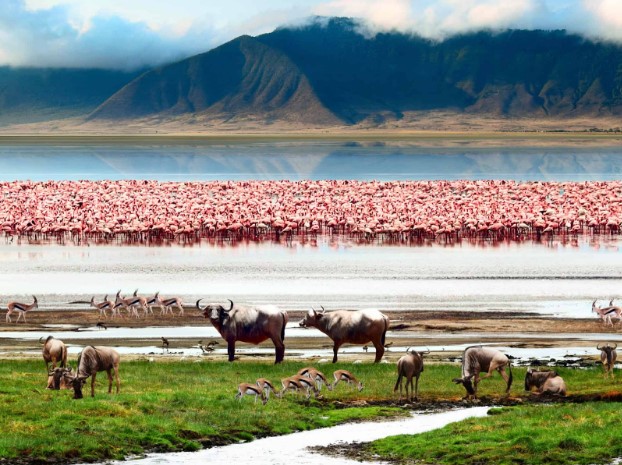
The alkaline lake dominating the park’s western boundary attracts impressive water bird concentrations when conditions favor algae growth supporting flamingo populations. During favorable periods, tens of thousands of flamingos create pink masses visible from great distances, accompanied by pelicans, cormorants, storks, herons, egrets, ibises, and countless other species. The diversity makes Lake Manyara exceptional for birding during safaris in Tanzania, with woodland, grassland, and wetland species all accessible within single game drives.
Designing Your Perfect Safari
Choosing Between Safari Formats
Safaris in Tanzania come in varied formats catering to different preferences, fitness levels, budgets, and adventure tolerances. Understanding format options helps visitors select experiences aligning with personal priorities.
Traditional vehicle safaris remain most popular, using modified 4×4 vehicles with pop-up roofs enabling standing for photography and viewing. These safaris vary from budget group tours using basic vehicles to luxury private safaris with top-of-the-line Land Cruisers equipped with charging stations, refrigerators, and premium binoculars. Vehicle safaris provide comfort, safety, and mobility allowing extensive park coverage impossible through other formats.
Walking safaris add thrilling dimensions by placing you on the ground where wildlife lives. Accompanied by armed rangers and expert guides, you’ll track animals on foot, learning to read signs like tracks and scat, understanding habitat preferences, and experiencing the heightened awareness that comes from being at ground level with potentially dangerous animals. Walking safaris during safaris in Tanzania create profound wilderness connections impossible from vehicle safety.
Fly-camping takes bush immersion to extremes through lightweight mobile camps established in remote locations for one or few nights. You’ll sleep in simple tents, eat meals prepared over campfires, and experience genuine wilderness without permanent camps’ infrastructure. This format suits adventurous travelers willing to sacrifice comfort for authentic bush experiences reminiscent of early safari traditions.
Balloon safaris in the Serengeti offer unique aerial perspectives on wildlife and landscapes. Floating silently at sunrise, you’ll observe herds from vantage points impossible from ground level while experiencing the peaceful meditation of silent flight. Post-flight champagne breakfasts in the bush add celebratory elements to these memorable morning adventures during safaris in Tanzania.
Investment Considerations
Budgeting for safaris in Tanzania requires understanding cost factors and making strategic choices aligning spending with priorities. Safari costs divide into several components: park fees (fixed costs per person per day), accommodation (ranging from $50 to $2,000+ per person per night), transportation (vehicle rental and fuel), guide services, and meals.
Budget safaris minimize costs through group tours sharing vehicles and guides, camping accommodation, and simplified meal arrangements, totaling approximately $200-400 per person per day all-inclusive. These safaris sacrifice comfort but not wildlife viewing—the animals don’t distinguish between accommodation levels.
Mid-range safaris utilizing comfortable lodges or tented camps with smaller group sizes and better meals typically cost $500-900 per person per day. These options balance reasonable comfort with manageable costs for multi-day safaris in Tanzania.
Luxury and ultra-luxury safaris deliver premium accommodations, gourmet dining, exclusive locations, small group sizes or private guiding, and exceptional service at costs ranging from $1,000 to $3,000+ per person per day. These options suit travelers prioritizing comfort, exclusivity, and premium experiences alongside wildlife viewing.
Seasonal timing significantly impacts costs, with peak dry season (July-October) commanding premium pricing while wet season (November-May) offers discounts of 30-50 percent for equivalent accommodations and services.
Conclusion
Safaris in Tanzania represent far more than vacations—they’re pilgrimages into wilderness that reconnect modern humans with natural rhythms and ecological relationships our ancestors understood intimately but contemporary civilization has largely forgotten. The experiences await—watching predators coordinate hunts demonstrating intelligence and cooperation rivaling human strategies, witnessing migration herds moving across plains in patterns unchanged for millennia, observing elephants displaying emotional depth and social complexity that challenges assumptions about consciousness, or simply sitting in wilderness as dawn breaks painting the Serengeti in impossible colors while lions roar their territorial claims and Africa awakens around you.
These encounters matter profoundly. They demonstrate why wilderness deserves protection, why conservation merits support, and why future generations deserve opportunities to experience these same wonders. Safaris in Tanzania succeed because they create advocates—every visitor returns home changed, carrying new perspectives on nature’s value and humanity’s responsibility toward species and ecosystems sharing our planet.
The wild places beckon. Tanzania’s protected landscapes still harbor wildlife in numbers approaching what existed before human population explosions threatened biodiversity worldwide. The opportunity remains to walk where elephants walk, to watch predators hunt as they have for millions of years, to witness migration spectacles that inspired human imagination since our species first looked across African plains. Safaris in Tanzania offer these experiences today, but they depend on continued conservation commitment and visitor support. Your journey awaits—will you answer the call?
Key Takeaways
- Safaris in Tanzania deliver authentic wilderness experiences in functioning ecosystems where wildlife thrives at densities and diversities unmatched globally, supported by protecting nearly 40% of national territory for conservation
- The northern circuit integrates complementary destinations—Serengeti’s endless plains and migration spectacle, Ngorongoro’s crater ecosystem, Tarangire’s elephant concentrations, and Lake Manyara’s habitat diversity—creating comprehensive safari experiences
- Seasonal timing profoundly influences experiences: dry season (June-October) optimizes visibility and migration drama while wet season (November-May) delivers lush landscapes, birthing seasons, superior photography, significant cost savings, and solitude
- Safari format options accommodate diverse preferences from traditional vehicle safaris to walking safaris, fly-camping, and balloon safaris, each delivering unique perspectives on Tanzania’s wildlife and landscapes
- Investment levels range from budget camping ($200-400 daily) through mid-range comfort ($500-900) to luxury experiences ($1,000-3,000+), all accessing identical wildlife with different comfort levels
- Professional guides transform safaris from wildlife viewing into educational experiences through expertise in behavior, ecology, and natural history accumulated over decades in the bush
- Tourism funding through safaris in Tanzania directly supports conservation operations, anti-poaching efforts, scientific research, and community development, creating sustainable models proving wildlife generates economic value justifying protection
Frequently Asked Questions
What makes safaris in Tanzania better than other African countries?
Safaris in Tanzania excel through unique combinations rarely found elsewhere. Wildlife abundance exceeds most destinations—the Serengeti ecosystem alone hosts over two million migrating animals plus substantial resident populations. Ecosystem diversity within compact areas means single safaris encompass varied habitats from volcanic craters to endless plains, each supporting distinct wildlife communities. Conservation success has restored populations to healthy levels, with thriving elephants, recovering rhinos, and stable predator numbers. Infrastructure balances wilderness preservation with visitor access through strategic lodge placement and professional guide training. The Great Migration, Earth’s largest terrestrial mammal migration, occurs primarily in Tanzania. Finally, Tanzania’s political stability and mature tourism sector ensure safety and reliable operations. While other countries offer excellent safaris, Tanzania’s combination of factors creates consistently exceptional experiences difficult to match elsewhere.
How physically demanding are safaris in Tanzania?
Standard vehicle-based safaris in Tanzania demand minimal physical fitness. Most time is spent sitting in vehicles during game drives, with occasional short walks at lodges or designated areas. Getting in and out of safari vehicles requires moderate mobility, and roads can be rough causing vehicle bouncing, but overall physical demands remain low. Walking safaris require higher fitness levels—expect to walk several hours over varied terrain including hills, thick vegetation, and uneven ground while carrying water and potentially standing motionless when encountering animals. Fly-camping involves basic facilities requiring more self-sufficiency than permanent lodges. Most operators accommodate physical limitations if informed in advance, adjusting itineraries appropriately. Age isn’t necessarily limiting—many travelers in their 70s and 80s successfully enjoy safaris in Tanzania focusing on vehicle-based game viewing. Discuss any concerns with operators when booking to ensure appropriate safari selection.
Can safaris in Tanzania be family-friendly?
Absolutely. Safaris in Tanzania offer exceptional family experiences combining education, adventure, and quality time in spectacular settings. Many lodges and camps specifically accommodate families through family tents, connecting rooms, or private houses. Some properties provide children’s programs featuring junior ranger activities, wildlife tracking lessons, and age-appropriate educational content. Most operators set minimum ages for certain activities—walking safaris typically require 12-16 years while game drives accept younger children with parental supervision. Considerations include malaria prophylaxis (discuss with pediatricians), sun protection, maintaining children’s interest during game drives, and managing expectations about sighting frequency and animal behavior. Successful family safaris often include shorter game drives with breaks, interactive activities beyond wildlife viewing, and accommodations with amenities like swimming pools. Many families report safaris as transformative experiences creating lasting memories and teaching children about nature, conservation, and global diversity in ways classroom education cannot replicate.
What wildlife can I realistically expect to see?
Safaris in Tanzania consistently deliver diverse wildlife encounters, though specific sightings depend on timing, locations, and luck. Virtually guaranteed sightings include elephants, zebras, wildebeest, various gazelles, giraffes, buffaloes, hippos, warthogs, and baboons—these species exist in such numbers that missing them would require extraordinary bad luck. Lions appear on most safaris, particularly in Serengeti and Ngorongoro, given their high populations and diurnal activity. Leopards require more patience given their nocturnal habits and solitary nature, but chances improve in areas like Seronera where kopjes provide favored habitat. Cheetahs frequent open plains where their hunting strategy succeeds. Black rhinos present the greatest challenge among Big Five, with Ngorongoro offering best chances. Beyond mammals, Tanzania’s 1,100+ bird species ensure spectacular birding. Realistic expectations help—you’ll see abundant wildlife, but specific animals appear unpredictably since they’re wild and follow their own schedules rather than performing for tourists.
Do I need travel insurance for safaris in Tanzania?
Yes, comprehensive travel insurance covering medical emergencies, evacuation, trip cancellation, and baggage loss is strongly recommended for safaris in Tanzania. Medical considerations are particularly important given distances from advanced medical facilities in most safari areas. Evacuation insurance proves critical since serious medical issues may require air ambulance transport to Nairobi or other cities with adequate facilities—costs without insurance can exceed $50,000. Trip cancellation coverage protects substantial safari investments if unexpected circumstances prevent travel. Many safari operators require proof of evacuation insurance before confirming bookings. When selecting policies, ensure coverage includes adventure activities like walking safaris, verify evacuation provisions include helicopter or air ambulance transport, confirm coverage extends to Tanzania specifically, and understand exclusions. Medical consultation before travel regarding vaccinations and malaria prophylaxis is essential regardless of insurance. While Tanzania’s safari areas are generally safe, insurance provides essential protection against unpredictable circumstances that could otherwise create financial disasters.
How should I prepare for safaris in Tanzania?
Preparation begins 2-3 months before departure. Schedule appointments with travel medicine specialists for vaccinations and malaria prophylaxis recommendations. Obtain necessary visas—most nationalities can apply for e-visas online. Book accommodations and safari operators early, particularly for dry season travel when availability becomes limited. Purchase comprehensive travel insurance covering medical evacuation. Begin assembling appropriate clothing and gear—neutral colors, layering options, sun protection, quality footwear, binoculars, and camera equipment. Research wildlife and ecosystems you’ll encounter to enhance appreciation during the safari. Consider fitness preparation if planning walking safaris. Arrange reliable transportation to/from airports. Notify banks and credit card companies about travel plans to prevent card blocking. Download relevant apps including field guides, bird identification tools, and offline maps. Create copies of important documents including passports, insurance policies, and booking confirmations stored separately from originals. Pack prescription medications in carry-on luggage with copies of prescriptions. Mentally prepare for adventure, flexibility, and embracing unpredictability—safaris in Tanzania deliver planned activities but wildlife encounters follow nature’s schedule rather than human itineraries.